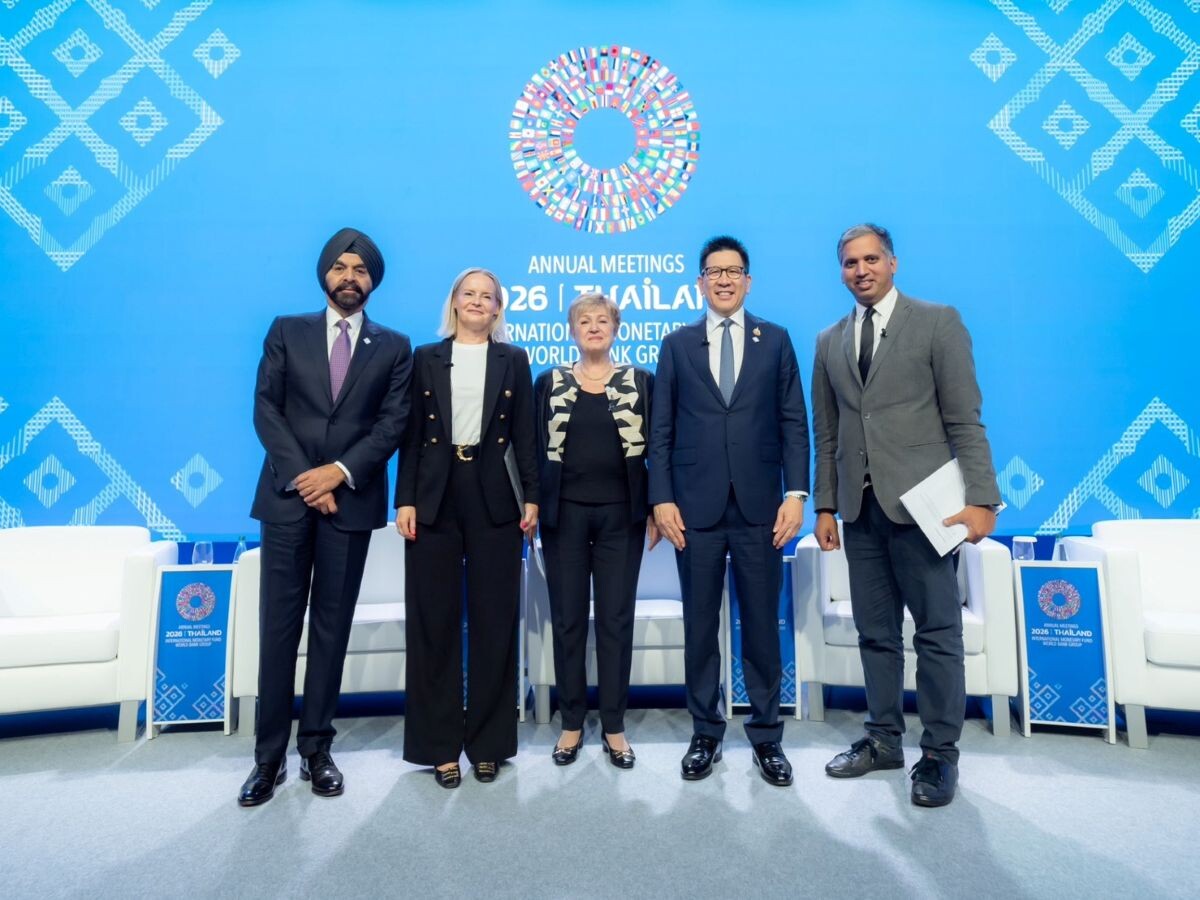
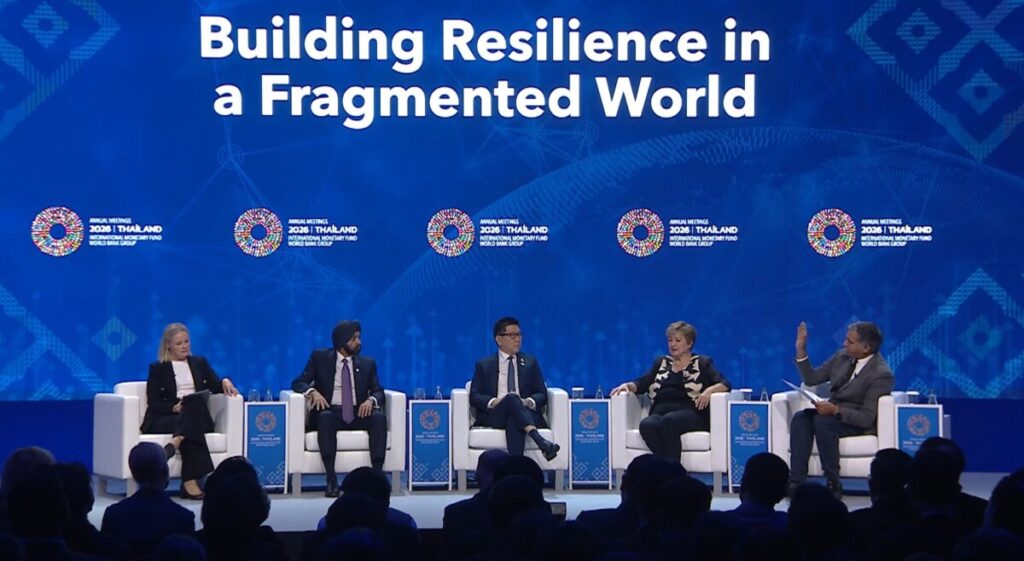
Global economic leaders convened to address the imperative of “Building Resilience in a Fragmented World” underscoring a fundamental structural shift across nations and businesses from an era of “efficiency first” to “security first.” Amid escalating geopolitical frictions, rising trade barriers, and systemic uncertainties, top policymakers and heads of international financial institutions underscored that retreat into self-sufficiency is economically untenable. Instead, international resilience demands proactive diversification, sound macroeconomic discipline, and the strategic empowerment of trusted connectors capable of bridging geopolitical walls.
Dr.Ekniti Nitithanprapas, Thailand’s Deputy Prime Minister and Minister of Finance, framed the global transformation through three critical conduits: trade, finance, and investment. In trade, Dr. Ekniti noted that commerce behaves like water hitting a barrier—diverting to navigate obstacles. Confronting its position as a net energy importer previously reliant on the Middle East for 50% of its energy supply, Thailand successfully reoriented its import channels toward West Africa and Latin America over the past seven to eight months, embodying the strategy of constructing bridges over protectionist walls.
Financially, macroeconomic stability and fiscal discipline have shielded the Thai economy; while 10-year US Treasury yields climbed 120 basis points, Thailand’s 10-year government bond yields rose by only 60 basis points over the same period. In foreign direct investment (FDI), application volumes to Thailand surged 47% during the first half of the year as global firms diversified supply chains. By dismantling bureaucratic hurdles, Thailand converted these inflows into private investment expansion exceeding 10% across two consecutive quarters.
Addressing the role of middle powers in navigating a “K-shaped” global impact, Dr.Ekniti emphasized Thailand’s role as a “trusted connector.” He cited regional power integration across ASEAN—channeling hydropower from Lao PDR to Singapore via Thailand and Malaysia—and the launch of the Digital Economy Framework Agreement (DEFA) as tangible resilience mechanisms. Dr. Ekniti maintained that international investment must translate into local capability, highlighting Thailand’s 40% export growth in AI-related industries and the rollout of the “Skill Bridge” initiative to upgrade workforce capabilities through technology transfers mandated under FDI incentives.
Kristalina Georgieva, Managing Director of the International Monetary Fund (IMF), warned that the structural costs of fragmentation remain perilous. While earlier IMF research projected global fragmentation costs could reach up to 7% of world GDP, current trajectories are persistently climbing toward that threshold. Georgieva identified the “opportunity cost of forgone cooperation” as the most profound loss, characterized by costly operational duplication, delayed technological breakthroughs, and the erosion of mutual trust.
Georgieva emphasized that fiscal and macroeconomic health serves as a nation’s foundational line of defense against compounding shocks. Pointing to past European crisis recoveries, she cautioned against mounting sovereign deficits, elevated debt levels, and soaring debt-service costs in systemically advanced economies. The IMF chief firmly rejected economic isolationism, urging nations to embrace market diversification and deepen regional integration. Eliminating non-tariff barriers in Asia could accelerate regional GDP growth by 1.8%, while an integrated European energy grid could reduce power costs by more than 10%.
Ajay Banga, President of the World Bank Group, outlined the structural reconfiguration of international trade. Over the past two decades, global trade flows quadrupled, with developing economies doubling their share from 20% to 40%—and intra-developing trade now accounting for 50% of that volume. Banga stressed that untapped regional trade opportunities remain substantial in South Asia, Africa, and Latin America compared to ASEAN’s 50-55% internal trade ratio, urging governments to implement and execute existing trade agreements by dismantling non-tariff barriers and streamlining customs procedures.
Banga highlighted a remarkable shift in capital markets: private capital mobilized by the World Bank for emerging markets reached 112 billion dollars last year, up from 32 billion dollars three years prior. Private capital decisions hinge on physical and digital infrastructure, human capital development, transparent governance, and targeted de-risking mechanisms. With 1.2 billion young people in emerging markets entering adulthood over the next 12 to 15 years, Banga stressed the critical necessity of supporting micro, small, and medium enterprises (MSMEs), which generate 75% of jobs across both developing and advanced nations. Banga advocated for institutional synergy through the “1+1=3” operational approach, citing mutual reliance frameworks with partners like the Asian Development Bank and the Thai government.
Riikka Purra, Deputy Prime Minister and Minister of Finance of Finland, presented the perspective of a small, open Nordic economy, arguing that small nations need not adopt the role of passive victims in a fragmented world. Grounded in a comprehensive security doctrine, Finland has cultivated institutional agility and energy resilience, boasting Europe’s most competitive electricity tariffs with 95% generated from low-carbon or fossil-free sources.
Purra cautioned against “over-securitization,” which risks undermining global open markets and competitiveness. Instead, she advocated for “selective de-risking” that targets specific supply chain chokepoints without abandoning open trade architecture. Small nations, Purra explained, can build strategic leverage by establishing “reciprocal dependencies” in high-competency sectors where they hold distinct comparative advantages—including Arctic technologies, telecommunications, critical mineral refining, cybersecurity, space technologies, and quantum computing. Purra also warned of market-distorting subsidy races within larger economic blocs like the EU, reaffirming that long-term resilience relies on market openness, strategic capabilities, and agile adaptation.