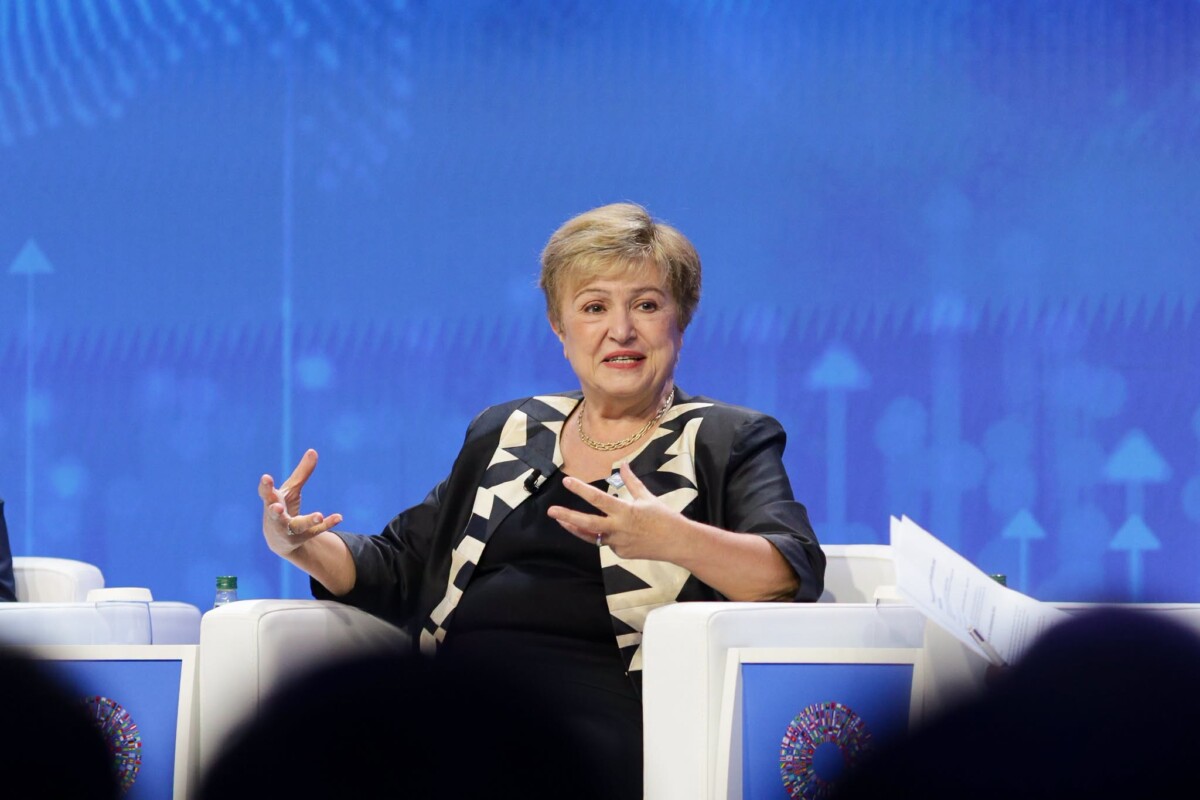
Global economic resilience is approaching its limits as fiscal and energy buffers wear thin, according to Kristalina Georgieva, Managing Director of the International Monetary Fund (IMF), speaking at the IMF-World Bank Annual Meetings 2026 in Thailand.
The IMF projects global economic growth at approximately 3.1% in 2026, holding steady from its April forecast but slowing down from the 3.4% recorded in the preceding year. Global economic momentum faces opposing forces: negative supply shocks stemming from the conflict in the Middle East pull growth downward, while surging demand linked to Artificial Intelligence (AI) provides upward momentum.
Economic divergence across regions is widening. Economies deeply integrated into the AI supply chain—notably Asian nations including Thailand, Malaysia, South Korea, and Singapore—along with energy-exporting countries unaffected by war, are outperforming peers. In contrast, low-income nations, fragile states, energy importers, and economies falling behind in technological adaptation face severe economic headwinds.
Sovereign bond yields in advanced economies have surged to multi-decade highs, driven by persistent inflation, strong investor demand, upgraded growth outlooks tied to AI, and underlying fiscal imbalances. This benchmark yield surge has spilled over into emerging markets and low-income economies, sharply escalating debt-servicing burdens at a time when post-pandemic fiscal buffers remain unreplenished.
The IMF urged policymakers worldwide to rebuild fiscal health before existing vulnerabilities worsen. Key recommendations include expanding state revenues, rationalizing public spending, and reforming public financial management. To address surging food and fuel prices, the IMF advised governments to protect people rather than prices through temporary, targeted assistance to vulnerable segments while preserving market pricing mechanisms. On monetary policy, central banks facing above-target inflation and strong activity should maintain a prudent hawkish bias to protect price stability.
Addressing AI developments, Georgieva highlighted Amara’s Law, cautioning that markets frequently overestimate short-term benefits while underestimating long-term gains, creating risks of disorderly market corrections. She also pointed to escalating AI-powered cyber threats against critical systems as a tangible risk to financial stability, urging governments to strengthen cyber resilience and invest in digital and energy infrastructure.
Regarding debt resolution, the IMF has reached a staff-level agreement with Senegal on a program valued at approximately 2.2 billion dollars to support fiscal stability. For ASEAN members navigating persistent global borrowing costs and domestic challenges—such as household debt in Thailand—the IMF underscored the need to expand intra-regional trade and leverage regional integration alongside digital and technological advantages.