In an era where Generative AI can flood the market with infinite, low-cost content, the creative industry faces a brutal paradox: as content becomes more abundant, human attention becomes increasingly scarce. The challenge for modern storytellers is no longer just about “looking good” or “going viral”—it is about bypassing a biological gatekeeper known as the Mental Ad-Blocker.
At the recent Spikes Asia festival, experts from the creative agency Casual shared a provocative insight: most content isn’t liked or disliked; it simply isn’t processed at all. To break through this “invisibility,” creators must pivot from designing content to designing connection.
The Neuroscience of “Immersion”
The key to moving an audience lies in a physiological state called Immersion. Developed through neuroscientific research, Immersion occurs when the brain releases oxytocin (associated with empathy and connection) and dopamine (associated with reward and attention) simultaneously.
Unlike traditional surveys, which rely on “self-reporting”—where people often post-rationalize their feelings—Immersion measures the subconscious.
- The 97% Accuracy Rule: In the music industry, studies have shown that tracking immersion during just 20 seconds of an unreleased song can predict whether it will be a hit with 97% accuracy. In contrast, top human producers have a hit rate of only about 30%.
- The “Give-a-Shit” Metric: If the brain doesn’t release these chemicals, it simply doesn’t care. Without this “pulse,” a message cannot influence behavior or drive action.
Resonance: The Brain’s Bouncer
Before immersion can happen, a story must first get past the Reticular Activating System (RAS)—the “bouncer” in the brain that filters out irrelevant noise. This is achieved through Resonance.
Resonance is the use of language, tone, and context that feels familiar to the viewer. When a piece of work feels “meant for me,” the RAS allows it through. A powerful example of this was seen in a Japanese whiskey brand: by shifting their creative from “social extroverts” to “quiet introverts” based on actual audience resonance data, they achieved a 56% revenue increase after years of flatlining.
The 5-Question Checklist for Modern Creators
To ensure your work has a “pulse” and avoids becoming beautifully crafted background noise, consider these five elements based on how the brain processes stories:
- Humanity: When does the story become relatable or show real human emotion?
- The Question: What curiosity or tension are you opening up to hook the viewer?
- The Turn: When does the “penny drop”? Where is the reveal that provides clarity?
- The Peak-End Rule: Are you protecting the most intense moment and the conclusion? (Humans tend to remember only the peak and the end of any experience).
- The Action: What is the clear next step you want the audience to take?
The Future of Creativity
As AI provides us with more drafts and formats than we could ever need, the real competitive advantage will not go to those who produce the most. It will go to those who produce something that feels real. In a world of digital abundance, care and connection are the only true scarcities. The ultimate question for agencies and brands is no longer “How much content can we scale?” but rather, “How deeply can we connect?”
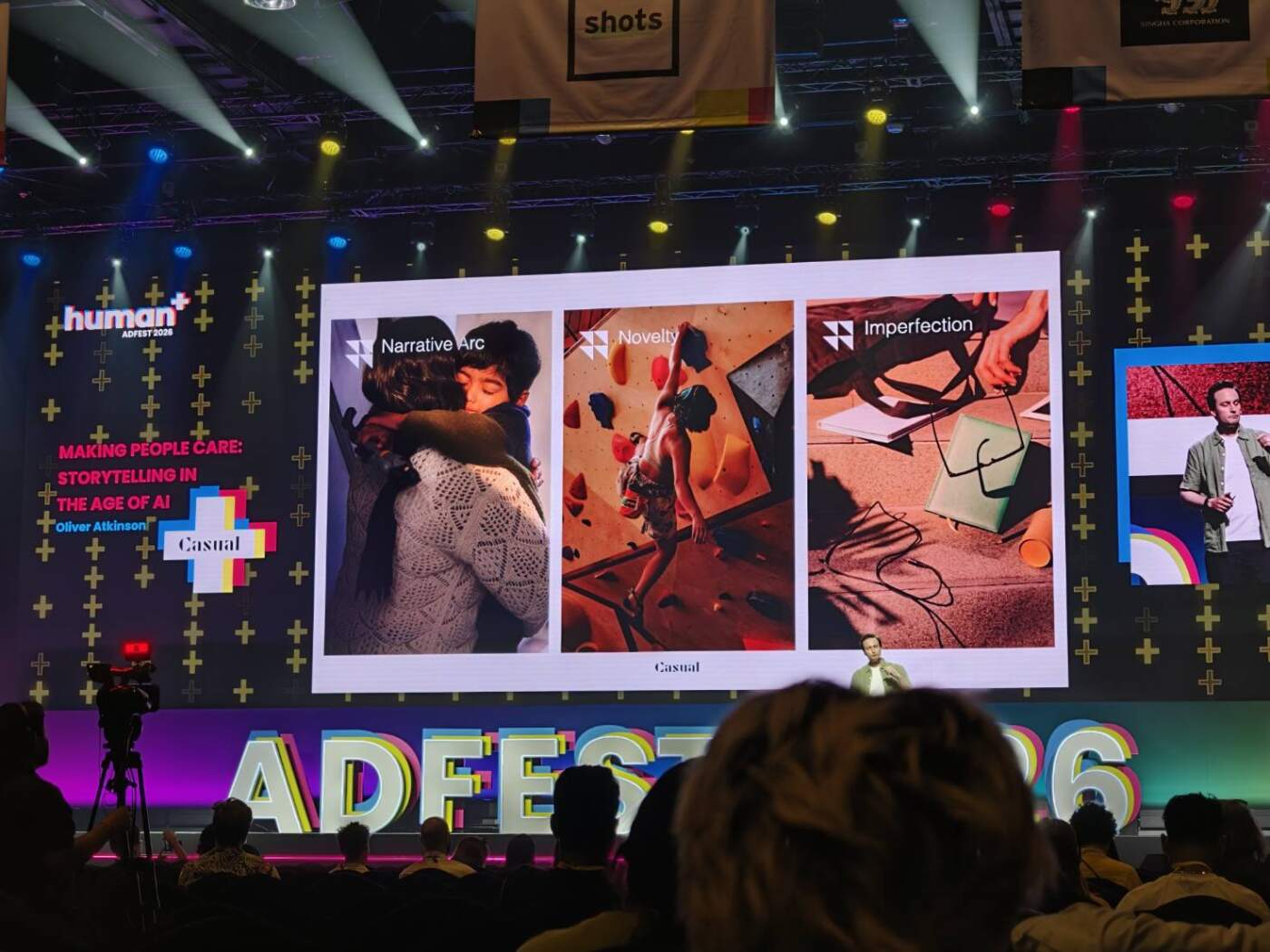
From: Making People Believe: Storytelling in the Age of AI @ ADFEST 2026
–ADFEST 2026 Returns to Pattaya with “Human+” Theme, Celebrating Humanity Empowered by Tech