KUALA LUMPUR, Malaysia – Petronas, the global energy giant and a Fortune Global 500 company, underscores its pivotal role in spearheading a progressive “Energy Transition.” The company proudly presents its robust performance in 2024 and outlines a strategic vision that balances energy security, affordability, and sustainability, all while addressing the world’s growing energy demand and steadfastly pursuing Net Zero Carbon Emissions by 2050.
In an era where global focus intensifies on climate change and sustainability, the private sector has emerged with a crucial role beyond that of governments. Petronas embraces this responsibility, integrating sustainability principles into every facet of its operations. This commitment aims to create sustainable value through responsible governance, serving as a fundamental pillar for a successful energy transition.
2024 Performance: A Testament to Sustainable Growth Potential
Petronas demonstrated strong capabilities in 2024, recording a revenue of RM 320 billion (equivalent to USD 70 billion). While slightly lower than 2023, the company maintained an average upstream production of 2,451 thousand barrels of oil equivalent per day (boepd). Simultaneously, it significantly scaled up its renewable energy capacity to 8.0 Gigawatts (GW) from 2.9 GW in the previous year, signaling proactive investments in clean energy. Furthermore, the company continued its substantial social investment, exceeding RM 700 million (equivalent to USD 153 million), reflecting its deep commitment to communities and society.
Three Strategic Pillars: Driving Towards a Low-Carbon World
Petronas’s energy transition strategy is built upon three interconnected and robust pillars:
- Core Business: More Energy, Less Emissions
- As a key player in the oil and gas industry, Petronas is dedicated to enhancing operational efficiency in both its upstream and downstream businesses to reduce greenhouse gas emissions. This is crucial for generating the necessary cash flow to fund investments in low-carbon technologies and renewable energy. A higher proportion of natural gas in its portfolio (two-thirds gas, one-third oil) provides a significant advantage, as natural gas has half the carbon content of coal.
- New Business: Capturing New Growth Opportunities
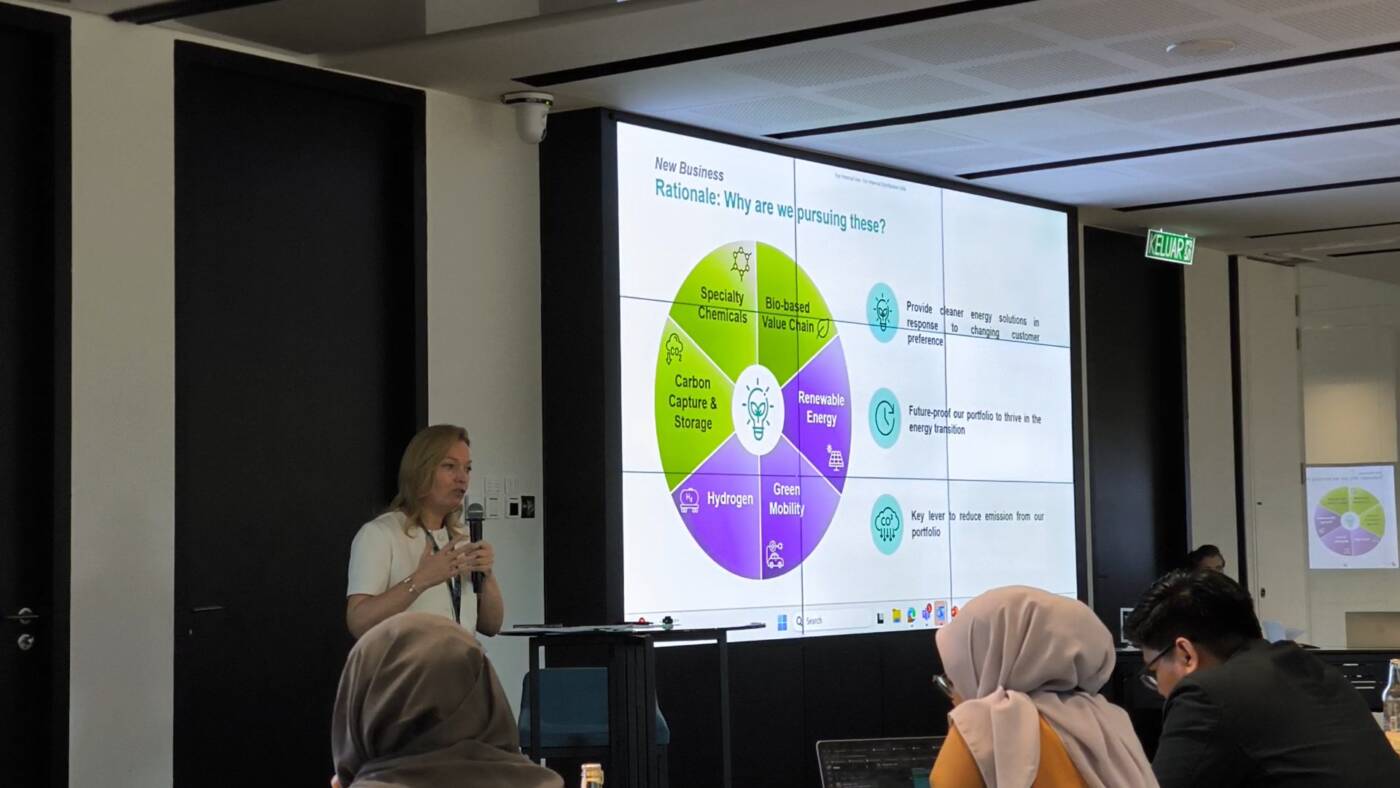
- Petronas is expanding its business horizontally into cleaner energy solutions and building a future-proof portfolio to drive the energy transition. This involves focusing on six key new business areas:
- Specialty Chemicals: Through strategic acquisitions like BRB and Perstorp, Petronas now offers advanced chemical solutions, including coating solutions, engineering fluids (e.g., for thermal management in data centers), personal care products (featuring smart ingredients like EMFINITY®), and advanced polymer solutions that promote recycling.
- Bio-based Value Chain: Leading the development of Sustainable Aviation Fuels (SAF) and other biofuels. This includes producing 100% sustainable fuels for Formula 1 cars in the near future and constructing Malaysia’s first biorefinery, expected to be operational in the second half of 2028.
- Carbon Capture & Storage (CCS): Developing CCS as a marketable service, positioning Malaysia as a potential CCS hub in the Asia-Pacific region.
- Renewable Energy: Accelerating investments and expanding renewable energy capacity, notably in solar power.
- Hydrogen: Expanding into emerging low-carbon hydrogen solutions by leveraging existing capabilities.
- Green Mobility: Capitalizing on the growth of electric vehicles by providing charging infrastructure across the region.
- Petronas is expanding its business horizontally into cleaner energy solutions and building a future-proof portfolio to drive the energy transition. This involves focusing on six key new business areas:
- Net Zero Carbon Emissions
- Petronas has set ambitious targets to achieve net zero carbon emissions by 2050, aligning with the Malaysian government’s aspirations. This includes peaking greenhouse gas emissions by 2024 and reducing methane emissions by 50% by 2025 (from Malaysian natural gas operations).
- Mid-term Targets (2030): Aims to reduce group-wide greenhouse gas emissions by 25%, and global methane emissions from its natural gas value chain by 70%, with a 50% reduction from measurable sources.
- Current Progress (2024): Petronas has cumulatively reduced over 21 million tonnes of greenhouse gas emissions since 2012, recorded 46.55 million tonnes of CO2e for its Malaysian operations (Scope 1), and achieved over 60% reduction in methane emissions from Malaysian natural gas operations compared to 2019 levels.
- Decarbonization Levers: The company deployed 41 emissions reduction projects across its Malaysian operations in 2024, leading to a reduction of 1.3 million tonnes of CO2e. Key strategies include zero routine flaring and venting, enhanced energy efficiency, electrification, and advancing Carbon Capture & Storage (CCS) projects.
- Methane Management: Recognizing methane’s higher global warming potential, Petronas is a regional leader in methane emission management through initiatives like the “ASEAN Energy Sector Methane Multiverse” and the establishment of the “Southeast Asia Methane Emission Technology Evaluation Centre” (SEA METEC) in Malaysia.
Driving Sustainability in All Dimensions: Nature and Society
Beyond its Net Zero ambitions, Petronas deeply integrates sustainability into other crucial dimensions:
- Thriving with Nature: Petronas is committed to no net loss of biodiversity from its existing operations and aims for a net positive impact on biodiversity for new projects. This includes explicit quantitative targets for biodiversity status and a plan to restore 30% of natural habitats by 2030. The company engages in habitat protection, risk management, and collaborations, actively participating in the “Blue Carbon Collective” research project to protect mangrove forests, with plans to plant 100,000 mangrove trees in Johor.
- Fostering a Just Transition: Petronas is dedicated to ensuring a just energy transition that respects human rights and creates equitable opportunities for socio-economic growth. A cross-divisional Just Transition Task Force, established in May 2024, focuses on three key areas:
- Employees: Developing staff capabilities to align with the evolving energy industry, partnering with Universiti Teknologi PETRONAS (UTP) for training in environmental and sustainable engineering, and energy management.
- Supply Chain: Launched the Petronas Supplier Support Programme (PSSP), a flagship initiative under Petronas’s Just Transition Roadmap. PSSP aims to drive an equitable and inclusive transition within the Oil & Gas Services & Equipment (OGSE) industry.
- PSSP Achievements: As of December 2024, over 1,016 Petronas supplier companies have engaged in the PSSP roll-out, with 23 virtual & physical engagements conducted in 2024 and 26 planned for 2025. Key tools include the Petronas Supplier Sustainability Hub (PSSH) and the Centralised Sustainability Intelligence Platform (CSIP), empowering suppliers with knowledge and resources for sustainability disclosures.
- Sustainable Financing: Three committed financial institutions (UOB, Bank Islam, Alliance Bank) provide tailored sustainable financing to PSSP suppliers, with UOB Malaysia allocating RM 1 billion for PSSP registrants. This highlights a strong commitment to enhancing the capabilities and sustainability readiness of its suppliers.
- Communities: Engaging with local communities to ensure the energy transition brings socio-economic benefits and opportunities for all.
Petronas is actively reshaping the energy industry by deeply embedding sustainability into every core aspect of its business. Through innovation, technology, and strategic collaborations, the company aims to drive sustainable economic growth while preserving the environment and fostering an equitable society for current and future generations.