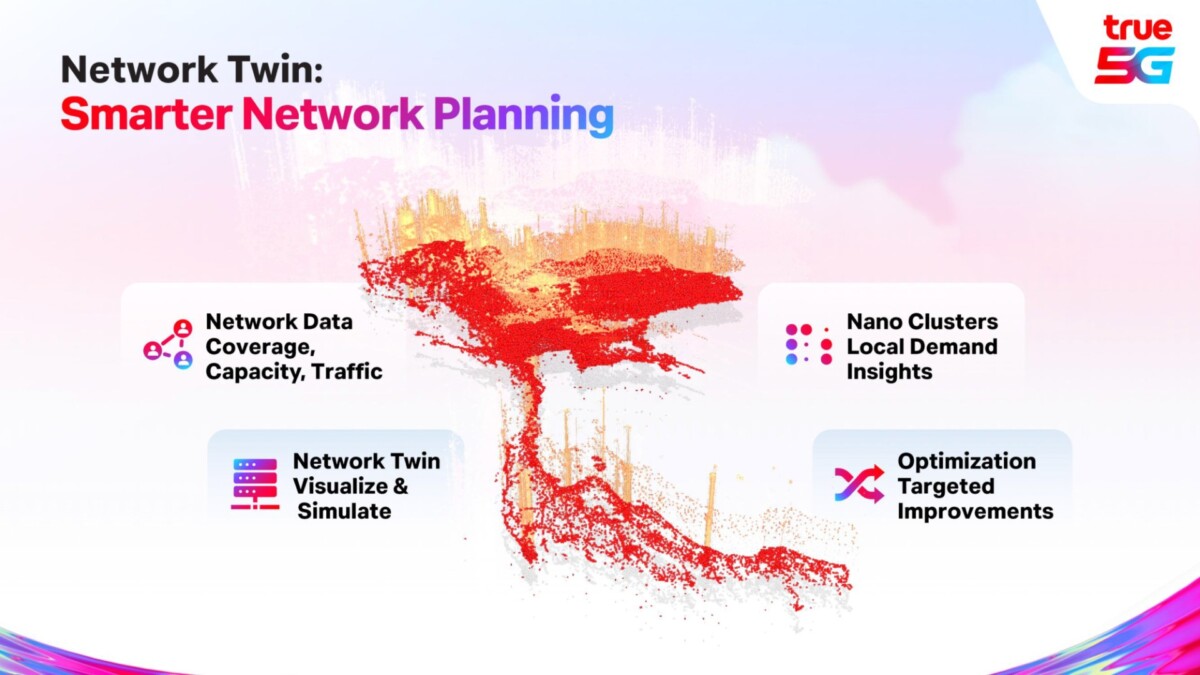
True Corporation has announced the deployment of “Network Twin” technology to build a virtual representation of its telecommunications infrastructure. By utilizing artificial intelligence for advanced predictive simulations before physical implementation, the company is laying the groundwork for an Autonomous Network to handle rising data consumption, which reached 38 GB per user per month, while scaling TRUE5GX connectivity from urban centers to remote island destinations.
Khurrum Ashfaque, Chief Network Officer of True Corporation Plc, stated that the company’s objective extends beyond expanding 5G coverage to delivering precision connectivity that adapts to evolving lifestyles. Given the divergent network demands across different geographies, True is merging advanced 5G architecture with big data analytics and AI to optimize network speed, capacity, reliability, and management nationwide.
True currently manages 48.8 million mobile subscribers, including 20.5 million 5G users as of Q3 2026. Data usage patterns show marked growth, with average monthly consumption reaching 38 GB per user in the first half of 2026—a 35% increase compared to pre-amalgamation figures—underscoring the surging need for robust connectivity.
To address this demand, True is accelerating TRUE5GX on 5G Standalone (SA) architecture. The network supports Carrier Aggregation across 2CC, 3CC, and 4CC configurations to combine frequency spectrums for maximized throughput and capacity, with 2CC and 3CC already active. TRUE5GX also incorporates “Priority Access” to ensure consistent, high-speed connections even during peak network congestion.
Central to this technological transformation is the Network Twin, a virtual digital replica spanning the Radio Network, Core Network, and Transport Network. Functioning similarly to Google Maps by rendering physical infrastructure into a dynamic digital environment, the system allows engineers to evaluate deployment scenarios prior to physical rollouts. Unlike conventional network monitoring systems that reactively detect and report faults, Network Twin proactively simulates network adjustments—such as deploying new base stations, tuning spectrum allocations, or managing localized surges—to mitigate operational risks and optimize energy efficiency in advance.
The system forms a Simulation & Intelligence Layer built upon four capabilities: Network Simulation (assessing coverage, capacity, interference, and energy metrics), Operational Impact Assessment (evaluating service reliability and operational risk), Opportunity Identification (optimizing spectrum and capacity), and Decision Intelligence (comparing deployment models to guide investment priorities).
True is integrating this simulation framework with its Nano Cluster strategy to cater to micro-level demands across residential districts, commercial centers, and tourist hotspots. In destinations like Krabi and southern marine corridors, where seasonal visitor traffic fluctuates, the platform models targeted capacity upgrades. This technical deployment extends across maritime travel routes and eco-sensitive locations, exemplified by the 5G deployment at Maya Bay in the Phi Phi Islands. There, True implemented Microwave Backhaul to deliver connectivity without installing optical fiber cables through protected terrain, utilizing environmentally integrated equipment design to safeguard natural surroundings.