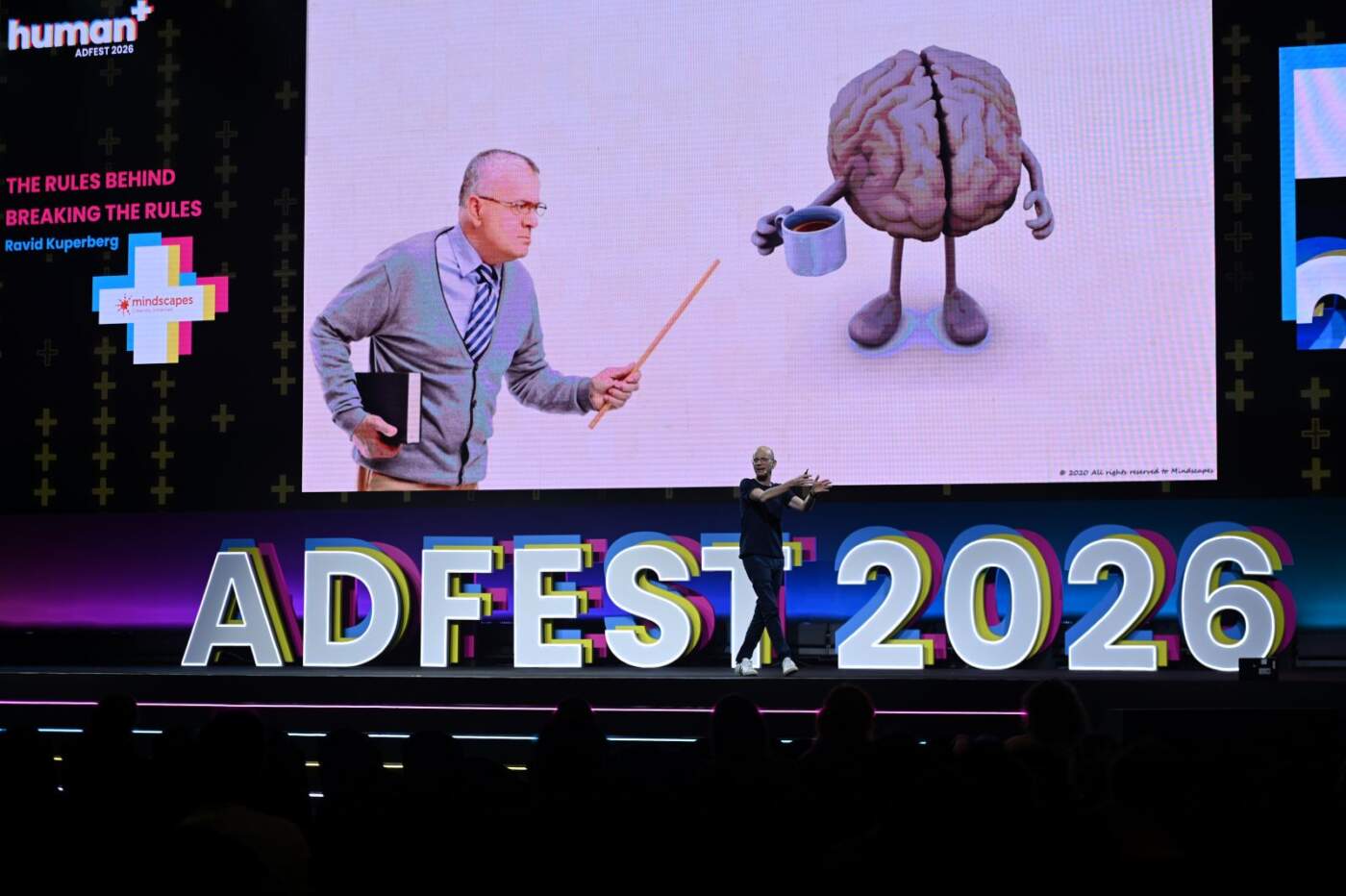
At ADFEST 2026, Ravid Kuperberg, Partner and Trainer at Mindscapes, took the stage to challenge the long-held belief that groundbreaking creativity is merely a stroke of luck or unbridled intuition. In his compelling session, “The Rules behind Breaking The Rules,” Kuperberg demonstrated that even the most disruptive ideas often follow structured, recurring patterns.
The 16 Patterns of Award-Winning Ideas Kuperberg shared a startling revelation: over 80% of Grand Prix and Gold winners at the Cannes Lions International Festival of Creativity can be traced back to just 16 recurring creative thinking patterns. While these winning campaigns appear entirely original and fresh, the underlying “spark” that ignited the creative process often shares a common structural DNA with other world-class ideas.
He emphasized that while AI and machine learning are rapidly evolving, the human mind remains the most essential “technology” for prompting bold, disruptive concepts that defy conventional logic.
Overcoming “Functional Fixedness” A primary obstacle to innovation, according to Kuperberg, is a cognitive bias known as Functional Fixedness. This mental trap causes us to automatically associate objects or systems only with their traditional roles. By failing to imagine alternative functions for existing components, our creative potential is severely limited. To truly “break the rules,” one must first recognize and bypass these deep-seated mental shortcuts.
The Power of Replication: Import and Export Kuperberg detailed the “Replication” pattern—a strategy where a solution or attribute from one environment is applied to a different, often unexpected context to solve a similar problem. He highlighted two primary strategies:
- Import: Bringing an external model into a brand’s ecosystem. A prime example is Renault’s “Plug-in” campaign, which adopted the Airbnb resource-sharing model to create a community-driven charging network for electric vehicles using private home chargers.
- Export: Taking a brand’s core attribute and applying it to a new domain. Ziploc, famous for food preservation, “exported” its life-extending promise to expired coupons. By allowing customers to upload photos of expired vouchers to unlock new discounts, Ziploc effectively “preserved” the value of the coupons just as they do with food.
By mastering these systematic patterns, creators can move beyond traditional boundaries to deliver work that is not only original but also deeply impactful in today’s competitive landscape.
–Beyond the Content Bubble: Why “Immersion” is the New Survival Metric in the Age of AI